
What this time does give me is the possibility to search and identify potential bonsai (potensai) in the form of yamadora that can be collected in the spring. One source of bonsai material that I have noticed is simply sitting next to many roads and tracks. Here in Finland there is a trench / ditch along the side of the road for the rain water to run into and for the snow to be pushed into during the winter months.
 Trees grow in these trenches which are cut each year by the verge cutters that come along to cut the grass and weeds. The continual cutting of the tops of the trees produces thick trunks that is the heart of any bonsai.
 Any type of common tree in our area can be found growing in the trenches as shown in the photos. The most common tree in the photo was Aspen (Populus Tremula) but there was also a Scots pine.
 I know that Aspen is not a common tree for bonsai material, but if nothing else it will allow me to continually improve on my bonsai skills. Now we wait for the spring to see how some of these trees look when removed from the ground.

 This is the same tree I purchased from Bauhaus that will need an immediate repot next spring, but you can already see that in a few years once the canopy has developed further this should be a nice tree.
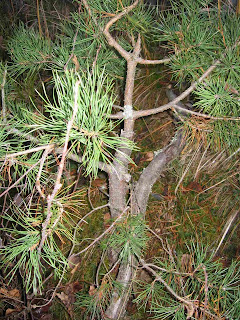
 This was located on the side of a rock and again the roots were all on the surface of the rock, making it easier to collect. Bringing along as many roots as possible, not forgetting the Mycorrhizal fungi, helps to make the survival rate of pine trees higher.
 The photos below show the sort of location that these potensai can be found. Places exposed to the weather where the wind can blow strongly and the tree is attached by only a little soil are ideal conditions for nature to make the sort of tree bonsai enthusiasts are interest in.

 The tree was found on top of a hill and completely exposed to the elements. There was not much soil around the tree and, fortunately for me, all the roots were growing on top of the rock that made up the hill.
  Once it was collected and back home I made the wooden box, I have learned that planting the tree back into the ground is not the best solution long term, that will be it's home for the next 2 years. I started immediately feeding the tree and continued to feed every 2 weeks with a balanced soluble feed. This it seemed to like because new needles started to appear in many areas, even areas that were almost without any needles. Now I need to nurse it through the winter and then wait patiently for next spring to see if I have learned something from my many hours of studying.
 The only problem is that the soil the tree is planted in is quite heavy. Ideally this should be changed to allow me to water and fertilize the tree like the others I have in my collection.
 Unfortunately this isn't the time of year to start repotting trees. I will take extra care of this tree during the Autumn and Winter months, especially with the watering, until I can change the soil in the spring.
 I have earlier had fukien tea trees and they have all died. I think this was mainly due my reluctance then to change the soil fearing that I would kill the tree that was growing so well at the time.


 Posts
Posts


